Here is a little ode to pencils:
 |
| Stop. Pencil time... |


You now know something weird about me.
|
| Stop. Pencil time... |
 11 stories - 204 pages
 So, I am official. Well... I'm official for a month, but I have all of the documentation I need to get registration stickers on my car. I'm going to wait though--I paid $20 for a temporary sticker that
 I didn't even need (was told it was needed in order to get an inspection, but the guy didn't even bat an eyelash or ask for it... grrr). I'm going to use this temporary sticker! I'll tell you what, it really helped taking care of some of the paperwork while I was still in New Hampshire--I've been here only a week and after one failed DMV trip, I have Maryland plates on my car after 1.5 hour wait. So, the above image is not my actual plate number, but it is what the plate itself looks like. This is the new Maryland design and I actually think it's kinda ugly. Sorry to all native MDers out there... I'd love to know what that building is supposed to be. I really did want the old plate (middle) though; I think it looks "governmental" not to mention classy. Thoughts?
 Oh well, it's "just a plate that no one looks at" according to my sister and she's completely right about that. But the thing is that I've had Texas plates for over 4 years now--the same plate. The same simple plate. I feel like it's got a simple design--
 I think I like it when none of the letters/numbers are obstructed with nonsense. I lived in New Hampshire for two years and didn't even register it there! But that was for financial reasons and sheer stubborn behavior (I didn't want to pay over $300 for plates, but low and behold, I'm paying exactly that now). I also wonder if the NH plate design had something to do with it too. The "live free or die" part was nice--I do like that motto. I don't know... this all feels like a bigger deal that what it really is, so lets move on.
 I'm just glad to have a car again... to be able to drive around and see my new neighborhood and scout out potential job prospects. Jobs... that's a subject for another post entirely.
 Sometimes I sit in class and find myself asking: "What the hell are they saying?"
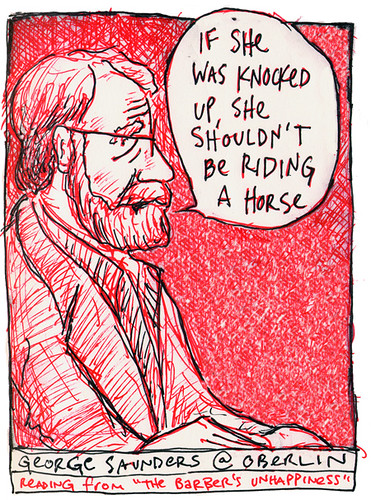 Reading update: I've put "Mr. Sebastian and the Negro Magician" on hold for the time being to read George Saunders, TC Boyle and Kurt Vonnegut. I'm working on Vonnegut's short story collection "Welcome to the Monkey House" at present. I like some of the stories and others, not so much. I love Saunders though. He's probably the first short story writer that I've connected with, for whatever reason. I actually feel semi productive reading these things--like I'm getting back into the school vibe.

 So, I have the book "The First Five Pages" by Noah Lukeman (who also wrote an amazing book on punctuation called "A Dash of Style"--I recommend it to everyone) and while I have yet to read Five Pages, I can tell, through context clues, that the first five pages of your manuscript are important. [I will be reading this book soon.] I also think that, for me, the first five lines of a story, particularly a genre story, are equally as important. I'm not talking about the first five lines of a published book, I'm talking about unpublished, amateur writing--of people longing to be published. For example, my fellow writers on autonomy.com (a new site that I'm uploading stories too for feedback). I know whether or not I want to "watch" or "back" a story within the first few lines.
 Why does workshop leave me with this dissatisfied, souls-just-been-sucked-out-and-stomped-on feeling? And I wasn't even workshopped today--that comes next week (story posted). I think part of my problem is that I read my story for next week again, after I'd already passed it out, and found LOTS of places that could have been cut or tightened up. I hate turning in sub-par things. And I'll hate hearing the same-ol' same-ol' next Monday. I feel like I'm one of the weaker writers in the program, which may or may not be true. I just feel like no one's giving me their true and honest to god responses, and then whisper behind my back.
 Wow, Wednesday night rocks again! I think it's something about my Chekhov/O'Connor class that gets the juices flowing, because I always come home and write for several hours (about six) and come up with a draft. My working title for this story: "Jesus in a Confederate Flag" (It's a Flannery O'Connor inspired story.) I know, it's a pretty quirky title--I'll post the story in a few weeks, I'm sure.
 I still wrestle with whether or not I'm in the right place. Whether or not I should be shelling out so much money on such a program. It's still a gamble. It's paying off in that I am learning (possibly at a subconscious level) and I do enjoy my classes and all the people I've met. But... is it right for me? My prof told me I'm writing at a Jedi Level 6. Please do not ask me what it means because I have no idea. (Perhaps Jedi Level 6 is what Yoda's reading to the right?!?!) Maybe it's better than that.... It seems like a nice level to be at and he was complimentary of parts of my work. But I just sat there staring at him while wondering just how many Jedi levels there are in writing fiction. Am I at six of 1,000,000? Six of 10? I should have asked him to specify. I also got the sense that he was telling me to be more proud of my work? That I should have a bigger ego about it? I got that sense. He picked up that I can be (am) too hard on myself. Shit--my poker face is slipping. Or he's just a fellow Empath and watches me a bit too keenly.
About Chekhov (thanks Wikipedia!)Anton Pavlovich Chekhov (January 29 [O.S. January 17] 1860 – July 15 [O.S. July 2] 1904) (Russian: Анто́н Па́влович Че́хов, Russian pronunciation: [ɐnˈton ˈpavləvʲɪtɕ ˈtɕɛxəf]) was a Russian short-story writer and playwright, considered to be one of the greatest short-story writers in world literature.[1] His career as a dramatist produced four classics: The Seagull, Uncle Vanya, Three Sisters, and The Cherry Orchard; and his best short stories are held in high esteem by writers and critics.[2][3] Chekhov practised as a doctor throughout most of his literary career: "Medicine is my lawful wife," he once said, "and literature is my mistress."[4]
Chekhov renounced the theatre after the disastrous reception of The Seagull in 1896; but the play was revived to acclaim by Konstantin Stanislavsky's Moscow Art Theatre, which subsequently also produced Uncle Vanya and premiered Chekhov’s last two plays, Three Sisters and The Cherry Orchard. These four works present a special challenge to the acting ensemble[5] as well as to audiences, because in place of conventional action Chekhov offers a "theatre of mood" and a "submerged life in the text."[6]
Chekhov had at first written stories only for the money, but as his artistic ambition grew, he made formal innovations which have influenced the evolution of the modern short story.[7] His originality consists in an early use of the stream-of-consciousnessJames Joyce and other modernists, combined with a disavowal of the moral finality of traditional story structure.[8] He made no apologies for the difficulties this posed to readers, insisting that the role of an artist was to ask questions, not to answer them.[9] technique, later adopted by
 Now, thankfully, our class is moving on to study Flannery O'Connor. I'm looking forward to this change of pace and what type of story I may be inspired to write after spending a few weeks reading her. I've been told that she has some wild stories--crazy Southern woman. This should be interesting...
Other news:
My workshop prof wants me to write non-fiction stories and just change the names to make them fiction. I don't know how I feel about this... please weigh in.

I read my Chekhov story out loud on Wednesday. I'll post it here sometime this week. I don't want to read out loud.
 So, I'm posting to avoid Chekhov. Surprised? Not me.
 I wrote a short story today.

Hit: the number of times a browser/visitor has accessed a story/chapter. Visitor: the number of unique hits, hits from unique IP addresses (Internet users), over a 24 hour period. For example, a reader named Jane accessing/reading 5 chapters of a story equals to 5 hits and 1 visitor. If Jane refreshes a chapter page 100 times, the system will record 100 hits, but only 1 visitor. If Jane came back the next day, more than 24 hours later, and perform the same task, the system would record 1 additional visitor. In summary, the visitor stat is the most important and accurate measure of reader traffic. Hits can be duplicates from the same reader.
It's a pretty cool feature actually because they also break it down by country.

I'm not really sure how it all works, I know that many countries listed (especially toward the end of the list) only contributed 1-2 hits or one visitors. But still, that's pretty cool that someone in Guam happened to find my story, at least one time. Doesn't mean they read it though. None of these particular stats mean people actually read, although many probably did. Some may skim and see a bunch of trash and decide not to read, who knows. The feature breaks down chapter stats too, so according to this each of my 21 chapters averaged about 200 visitors in August (in 12 days).
Seems a little incredible, but the story was up for a Some Kind of Wonderful Award (the story did win too, btw), so maybe that's where this influx came from. It's a contemporary romance, I suppose, or shall maybe I should call it "women's fiction". I don't know how to place it. It's fluff... nothing serious, something for you to -- hopefully -- be entertained. For my program I'll be writing in a more literary style, but I plan to try to publish both styles. Anyway, read if you like, but be warned... it's a first draft and full of errors of all sorts.
Competition aside, the story itself is on the favorite lists of 454 FictionPress readers/writers. That's a lot of people.
I wonder if I could use any of this information in query letters to agents? Maybe I should work on editing this story because it's a rough draft now and needs lots of work.
Please share your opinion.
I think my writing lapse the past few weeks is from feeling overwhelmed. Overwhelmed by my move and the pressure that I've put on myself to be some great writer. I'm hoping that it'll go away once I finish a task on my ever growing list. We'll see. Like Margosita pointed out, soon I won't have any choice and I'll have to write. Hopefully it won't be crap. One big thing that I did learn from King's book -- and pretty much knew already -- is that I need to be a better reader. I need to make better choices and I need to challenge myself. Now's the time and grad school will definitely force me to do that."Writing isn't about making money, getting famous, getting dates, getting laid or making friends. It's about enriching the lives of those who read your work, and enriching your own life, as well. It's about getting up, getting well, and getting over. Getting happy, okay? Getting happy."
"The rest of [this book] -- and perhaps the best of it -- is a permission slip: you can, you should, and if you're brave enough to start, you will. Writing is magic, as much the water of life as any other creative art. The water is free. So drink. Drink and be filled up."


